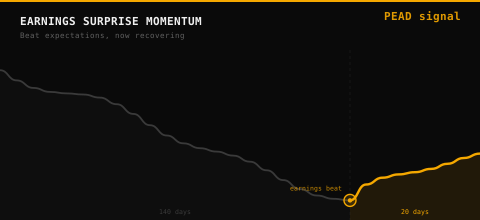
Beat expectations, now recovering
Earnings surprises are one of the most reliably studied anomalies in market research. When a company beats analyst estimates, the stock typically drifts upward over the following weeks — a phenomenon known as Post-Earnings Announcement Drift (PEAD). This preset captures that dynamic while adding a recovery twist: the stock must also have been underperforming over the past 140 days, meaning the market hasn't yet fully priced in the improving fundamentals.
The combination creates a compelling setup: strong recent earnings momentum, a stock that's been beaten down long-term, and a short-term uptick suggesting the recovery is already beginning. The Beta cap below 1.3 keeps out highly volatile names where the earnings signal tends to be noisier.
This strategy draws on academic work around PEAD (Bernard & Thomas, 1989) and mean-reversion momentum models, where stocks recovering from prolonged weakness but showing fundamental improvement have historically offered above-average risk-adjusted returns.
Screening Criteria
| Parameter | Condition | How it's applied |
|---|---|---|
| Earnings Growth YOY | > 15% | Screener filter (proxy for earnings beat) |
| Short-term Return (20d) | > 5% | Live price history — pipeline computed |
| Long-term Return (140d) | < 0% | Live price history — pipeline computed |
| Beta | < 1.3 | Screener filter |
| Market Cap | > $500 M | Screener filter |
A note on earnings surprise data
The ideal filter for this strategy would use the raw earnings surprise percentage from the most recent quarter (how much the actual EPS exceeded analyst consensus). We use Quarterly Earnings Growth Year-over-Year above 15% — which captures the same underlying dynamic of accelerating profitability. The detailed earnings surprise figures are included in the newsletter analysis for the companies that pass the screen.
Who is this for?
Investors comfortable with medium-term holding periods (weeks to a few months) who want exposure to companies with proven earnings momentum that haven't yet been fully re-rated by the market. The long-term weakness requirement acts as a built-in contrarian filter — you're not chasing already-expensive momentum stocks.