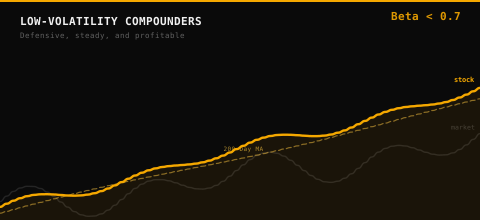
Defensive, steady, and profitable
Low-volatility investing has one of the most robust track records in academic finance. Despite conventional wisdom that higher risk should mean higher return, empirical research consistently shows that low-beta stocks outperform high-beta stocks on a risk-adjusted basis — a finding known as the low-volatility anomaly.
This preset targets companies that combine low market sensitivity with genuine business quality: strong profit margins that prove pricing power, solid returns on equity that show efficient capital allocation, and a price trading above its 200-day moving average — confirming the business is in a long-term uptrend rather than a slow decline. The short interest cap below 4% filters out names where institutional investors are actively betting against the company.
Together these filters select companies that compound steadily over time without dramatic swings — the kind of holding that lets you sleep at night, especially during uncertain or volatile market conditions. Inspired by research from Frazzini & Pedersen (Betting Against Beta, 2014) and Baker, Bradley & Wurgler (Benchmarks as Limits to Arbitrage, 2011).
Screening Criteria
| Parameter | Condition |
|---|---|
| Beta | < 0.7 (positive) |
| Price vs. 200-Day MA | Price > 200-Day Moving Average |
| Profit Margin (TTM) | > 15% |
| Return on Equity (TTM) | > 12% |
| Revenue Per Share (TTM) | Positive (trend monitored in newsletter) |
| Short Interest (% Float) | < 4% |
A note on Revenue Per Share trend
The ideal filter here would confirm that Revenue Per Share has been growing consistently over recent quarters — a sign the business is expanding its revenue base without excessively diluting shareholders. The screener enforces that the value is positive, while the Backseat Alpha newsletter analysis provides commentary on whether the trend is improving, stable, or declining for each company that passes the screen.
Who is this for?
Risk-averse investors, retirees, or anyone building a defensive core portfolio who still wants exposure to high-quality, profitable businesses. Also well-suited as a market hedge during periods of elevated macroeconomic uncertainty, when low-beta stocks historically hold up better than the broader market.