Tomorrow's leaders, today's prices
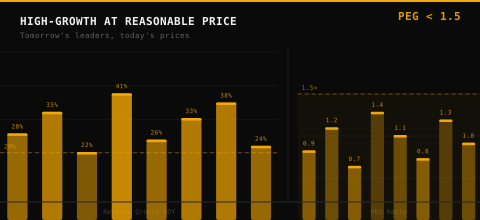
GARP — Growth at a Reasonable Price — was popularized by Peter Lynch and represents one of the most enduring investment philosophies: don't overpay for growth, but don't avoid it either. The PEG ratio (P/E divided by earnings growth rate) is more complete than P/E alone because it accounts for how fast the business is actually expanding.
This preset tightens the classic GARP definition with a revenue growth floor of 20%, a Forward P/E cap of 30 (ruling out truly speculative pricing), and an operating margin above 12% — confirming the growth translates into real profitability, not just top-line expansion. The EPS estimate requirement (next year must exceed this year on positive earnings) filters for companies where analysts expect the trajectory to continue upward.
The $2B market cap floor keeps the universe in large and mid-cap territory, where analyst coverage makes EPS estimates meaningful.
Screening Criteria
| Parameter | Condition |
|---|---|
| Quarterly Revenue Growth YOY | > 20% |
| EPS Estimate Next Year | > EPS Estimate Current Year (both positive) |
| PEG Ratio | > 0 and < 1.5 |
| Forward P/E | > 0 and < 30 |
| Market Cap | > $2 B |
| Operating Margin (TTM) | > 12% |
A note on the EPS growth threshold
The ideal filter would enforce that next-year EPS estimates exceed current-year by at least 15%. The screener enforces the direction (next year higher, on positive current-year EPS), while the Backseat Alpha newsletter calculates and reports the exact EPS growth percentage for each company — letting you see which names clear or comfortably exceed the 15% target.
Why PEG matters
A stock with a P/E of 25 and 25% earnings growth has a PEG of 1.0 — attractive by GARP standards. The same P/E on a company growing at 5% per year gives a PEG of 5.0 — expensive relative to its growth. Capping PEG at 1.5 means paying at most 1.5× the growth rate, a threshold historically associated with above-market returns even in growth-heavy portfolios.
Who is this for?
Growth-oriented investors who want discipline baked in. If you believe in owning tomorrow's category leaders but want to avoid overpaying for hypergrowth, GARP offers a middle path: real growth, real profitability, and a price that still reflects respect for valuation.